

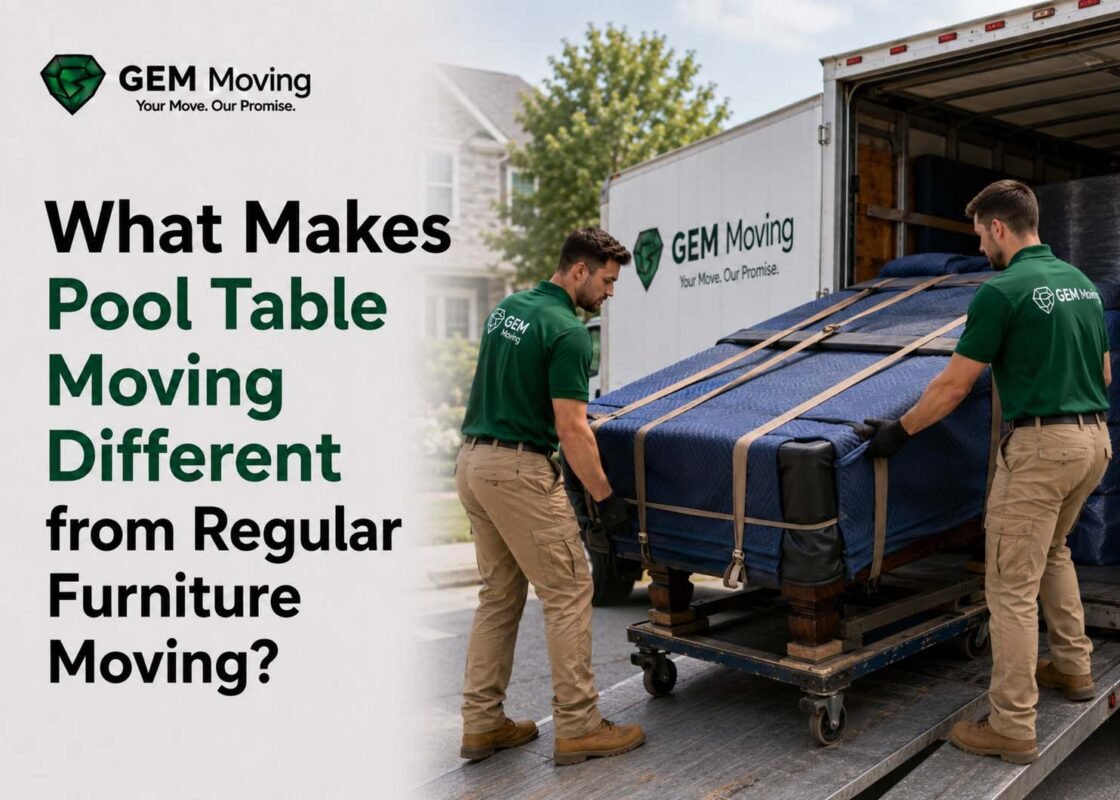
A sofa can often be wrapped, lifted, and carried directly to the truck. A pool table cannot.
Most pool tables must be taken apart before they leave the room. The rails, felt, slate, frame, legs, pockets, and hardware need different handling methods. A small mistake during disassembly or setup can affect the table’s structure and how the balls roll.
Professional pool table moving protects more than the table’s finish. It protects the slate, playing surface, frame alignment, property, and final level of the table.
TL;DR
Pool tables are heavier, more delicate, and more complicated than regular furniture. Safe relocation requires careful disassembly, protected slate transport, organized hardware, correct reassembly, and precise levelling at the destination. Standard furniture-moving methods are not enough.
Key Takeaways
- Pool tables should not usually be moved as one complete piece.
- Slate sections are heavy and can crack if handled incorrectly.
- The felt must be removed without unnecessary stretching or tearing.
- Rails, pockets, legs, and hardware need separate protection.
- The moving route must be measured before disassembly begins.
- Correct reassembly affects stability and gameplay.
- The table should be levelled in its final position.
- Experienced pool table movers reduce the risk of structural and property damage.
Table of Contents
- Why Pool Tables Are Harder to Move
- Why Disassembly Is Usually Required
- How Slate Changes the Moving Process
- How Movers Protect Felt, Rails, and Accessories
- How Pool Table Transport Differs from Furniture Transport
- Why Reassembly and Levelling Matter
- How to Prepare for Pool Table Relocation
- How to Choose Professional Pool Table Movers
- Frequently Asked Questions
Why Is Pool Table Moving More Complicated?
A pool table is not simply a large table with a felt-covered surface. It is a fitted system of heavy and carefully aligned parts.
Depending on the model, it may include:
- One-piece or multi-piece slate
- Wooden frame
- Support beams
- Cabinet
- Rails and cushions
- Felt or cloth
- Pockets
- Legs
- Levelling hardware
- Bolts, screws, and brackets
Each part affects the table’s strength or playing surface.
Regular furniture can often tolerate controlled tilting and rotation. A pool table should not be turned, dragged, or lifted from any available edge. Uneven pressure can affect the frame, legs, rails, or slate.
Weight is another issue. Slate is dense and difficult to control. Even when several people can lift the table, that does not mean they can move it safely through stairs, doorways, and tight corners.
G.E.M Moving handles home billiard tables, commercial tables, snooker tables, antique tables, coin-operated tables, and both slate and non-slate models. Its process includes disassembly, component protection, transportation, reassembly, and levelling.
Why Do Pool Table Movers Disassemble the Table?
A pool table is normally disassembled because moving it in one piece creates several risks.
The complete table may be too wide for doorways or hallways. Its weight can also make it difficult to control on stairs. Lifting from the cabinet or rails may place pressure on parts that were not designed to support the full table during transportation.
Professional pool table movers commonly separate:
- Pockets
- Rails
- Felt
- Slate sections
- Cabinet or frame
- Legs
- Levelling components
- Small hardware
The exact sequence depends on the table’s design.
The Pockets and Rails Come Off First
Pockets may be attached with screws, bolts, staples, or other fittings. Movers identify the attachment method before removing them.
The rails are then detached from the table. They should be labelled according to their original positions because their fit and alignment may differ slightly.
Rails need padding during transportation. Placing them loosely inside the truck can damage the wood finish or rubber cushions.
The Felt Requires Controlled Removal
The cloth may be stapled or glued to the slate.
Stapled felt must be released carefully to avoid tearing the edges. Glued cloth requires a different method because pulling too quickly may stretch or damage it.
If the felt is worn, torn, or already stretched, the move may be a good time to replace it. This decision should be made before reassembly.
Hardware Must Stay Organized
Bolts and screws from different sections should not be placed into one unlabelled bag.
Professional movers group and label hardware so each piece returns to the correct position. Missing or mixed hardware can slow reassembly and affect the table’s stability.
G.E.M Moving states that its crew removes slate sections, protects individual components, and organizes the table for professional reassembly at the destination.
How Does Slate Affect Pool Table Relocation?
Slate is one of the main reasons pool table relocation differs from moving ordinary furniture.
The slate creates the flat playing surface beneath the felt. It may be made as one large piece or divided into three sections.
Slate Is Heavy
Slate sections require controlled lifting and enough crew members to manage the weight.
The movers must maintain a stable grip without placing their hands in unsafe positions. Sudden movement on stairs or uneven ground can shift the weight quickly.
A one-piece slate can be particularly difficult because it cannot be divided into smaller sections. Access conditions may determine whether the table can be moved safely.
Slate Can Crack
Slate is strong while supported correctly, but it can crack if dropped, struck, twisted, or carried with poor support.
A damaged slate section may affect the playing surface and may be difficult or expensive to replace. For older or custom tables, a matching replacement may not be easy to find.
Each slate piece should be wrapped and secured separately. Nothing heavy should be stacked against it during transportation.
Multi-Piece Slate Must Be Rejoined Correctly
Three-piece slate tables have seams between the sections.
During reassembly, the sections must be aligned so the playing surface remains even. The seams may need preparation before the felt is installed again.
A visible table may appear level while small height differences remain between the slate pieces. Those differences can affect ball movement.
G.E.M Moving identifies slate type, table size, stairs, access conditions, distance, and required services as factors used to plan and price a pool table move.
How Do Billiard Table Movers Protect the Felt, Rails, and Accessories?
The slate receives much of the attention, but the remaining parts also need protection.
Felt
The felt should be folded or rolled according to its condition and removal method. Heavy objects should never be placed on top of it.
Moisture, dust, sharp tools, and dirty truck floors can damage the cloth. It should remain wrapped and separate from hardware.
Rails
Rails often have finished wood surfaces and rubber cushions. They need moving blankets or other suitable padding.
The crew should avoid placing pressure on the cushion edges. Rails must also be kept away from heavy items that may shift during transport.
Frame and Legs
The frame supports the slate and helps maintain the table’s shape.
Movers inspect the frame while taking it apart. Loose joints or previous damage should be identified before transportation.
Legs are wrapped individually to protect their finish. Decorative or carved legs require additional care around edges and corners.
Pockets and Accessories
Pool balls, cues, racks, chalk, brushes, table covers, and other accessories should be packed separately.
Pool balls should not remain loose inside the table or pockets. A complete ball set is heavy enough to damage other accessories if it moves inside an unprotected box.
Cue sticks need a suitable case or rigid container. Leaning them loosely inside the moving truck can cause warping or breakage.
G.E.M Moving recommends packing cues, balls, racks, and other accessories separately before the table is relocated.
How Is Pool Table Transport Different from Furniture Transport?
Regular furniture is often wrapped and loaded in the form in which it is used. Pool table transport involves several protected components that must remain organized throughout the journey.
Parts Need Separate Positions in the Truck
Slate, rails, legs, frame sections, pockets, felt, and hardware should not be loaded as one group.
Heavy slate needs strong support. Finished wooden parts require padding. Felt and accessories need a clean, dry location.
The loading plan should prevent boxes or furniture from falling against the table components.
Components Must Be Secured
Normal driving creates movement through braking, turns, road vibration, and uneven surfaces.
Straps and suitable anchor points help keep components in place. Slate sections should not be allowed to slide or strike each other.
G.E.M Moving says its crews wrap the components, secure the slate, and load the table to prevent movement and damage during transportation.
The Route Requires Advance Planning
Professional movers check:
- Door widths
- Hallway widths
- Staircases
- Landings
- Ceiling clearance
- Elevator size
- Basement access
- Outdoor paths
- Parking distance
- Loading space
The destination requires the same review.
A table that came through a wide basement entrance at the pickup property may need to pass through a narrow staircase at the new home.
Send photographs of both routes before moving day. Include every staircase, doorway, turn, and outdoor access point.
Why Do Reassembly and Levelling Matter?
Ordinary furniture is often ready for use once its legs and shelves are reattached. A pool table requires more exact setup.
The Frame Must Be Stable
The movers assemble the legs, frame, and support structure before installing the slate.
Bolts must be tightened correctly. A loose or uneven frame can affect the slate and create movement over time.
Slate Sections Must Align
The slate is placed onto the frame in the correct order. Multi-piece sections need to sit at equal height without gaps or raised seams.
The team checks the surface before reinstalling the felt.
Felt Must Be Installed Evenly
The cloth must lie flat across the slate. It should not have wrinkles, loose sections, or unnecessary tension.
Incorrect installation may affect ball speed and direction. Excessive stretching can also shorten the life of the cloth.
The Table Must Be Level
A pool table can look straight while still being slightly uneven.
Professional levelling checks the playing surface at several points. Adjustments may be made through the legs, frame, or levelling components depending on the table design.
Final levelling should happen after the table is placed exactly where it will remain. Moving it again may change the setup.
G.E.M Moving includes reassembly and professional levelling as the final step of its pool table moving service.
How Should You Prepare for Pool Table Moving Services?
Preparation helps the movers assess the work and prevents delays.
Identify the Table
Tell the moving company:
- Table size
- Brand, if known
- Slate or non-slate construction
- One-piece or multi-piece slate
- Residential or commercial model
- Approximate age
- Current condition
- Previous repairs or modifications
G.E.M Moving’s quote form accepts details for 7-foot, 8-foot, and 9-foot tables, along with slate, non-slate, antique, commercial, snooker, and other table types.
Measure the Route
Measure doorways, staircases, hallways, and elevators. Do not rely on visual estimates.
Remove furniture, rugs, artwork, plants, and loose items from the route.
Tell the mover about:
- Sharp turns
- Narrow basement stairs
- Low ceilings
- Uneven outdoor paths
- Limited truck parking
- Long carrying distances
- Elevator booking rules
Choose the Final Position
Decide where the table will go before reassembly begins.
Leave enough space around all sides for players and cues. Check lighting, electrical outlets, vents, radiators, windows, and ceiling fixtures.
Once the table has been assembled and levelled, it should not be pushed across the floor.
Pack Accessories
Place balls, racks, chalk, table brushes, covers, and small parts in labelled boxes.
Keep valuable or custom cues with you where possible.
How Do You Choose Professional Pool Table Movers?
Not every moving crew has experience with billiard tables.
Ask each company:
- Do you move slate and non-slate tables?
- Have you moved this size and model before?
- Is full disassembly included?
- How will the felt be removed?
- How will slate sections be protected?
- Is reassembly included?
- Will the table be levelled?
- Can you manage basement stairs?
- What insurance protection applies?
- Is storage available?
- What could increase the quoted price?
The company should request table and access information before providing a final quote.
A price given without asking about the slate type, stairs, table size, and locations may not reflect the actual work.
G.E.M Moving provides local and long-distance pool table moving services for homes, apartments, basements, game rooms, bars, recreation centres, and other commercial spaces. The company also offers temporary storage for pool tables and accessories.
Pool Table Moving Compared with Regular Furniture Moving
| Moving Step | Regular Furniture | Pool Table |
| Initial preparation | Empty and wrap the item | Inspect table type, slate, condition, and access |
| Disassembly | May remove legs or shelves | Remove pockets, rails, felt, slate, frame, and legs |
| Main moving risk | Scratches, dents, or broken joints | Cracked slate, torn felt, frame damage, poor alignment |
| Packing method | Blankets and protective wrap | Separate protection for every component |
| Transportation | Often moved as one item | Components loaded and secured separately |
| Setup | Basic reassembly | Frame setup, slate alignment, felt installation, and levelling |
| Final check | Confirm stability and condition | Confirm stability, level surface, and proper gameplay |
Frequently Asked Questions
Can a pool table be moved without taking it apart?
Most slate pool tables should be disassembled before moving. Carrying one complete can damage the frame, legs, slate, property, or people handling it. The table type and access conditions determine the correct method.
How long does pool table moving take?
The time depends on the table size, construction, stairs, access, moving distance, and condition. Disassembly and reassembly often take longer than the actual transportation.
Can pool table movers reuse the existing felt?
Existing felt may be reused if it can be removed without serious stretching or damage. Old, worn, glued, or torn felt may need replacement. Discuss its condition before moving day.
Do professional pool table movers level the table?
A complete service should include levelling after reassembly. Confirm this in writing because transportation alone does not guarantee that the table will be ready for play.
How far ahead should I book pool table moving services?
G.E.M Moving recommends booking one to two weeks ahead, especially during busy moving periods. More notice may be needed for long-distance moves, difficult access, commercial tables, or temporary storage.
Protect the Table from Disassembly to Final Setup
A pool table cannot be handled like a dining table or cabinet. Its slate, felt, rails, frame, and levelling system require separate attention at every stage.
G.E.M Moving provides professional pool table moving with disassembly, component wrapping, secure transportation, reassembly, and levelling. Share the table size, slate type, stairs, access conditions, pickup location, and destination when you request a free moving quote.